




Have you ever noticed that when it comes to skincare, while you can gradually restore your face’s health with face masks and serums, no matter how much you apply to your neck, it just doesn’t seem to work? For many people, the first time they really notice neck lines is when they’re looking down at their phone or when a camera captures their profile—those horizontal lines are more revealing than nasolabial folds and give away your age even more than wrinkles do.
It’s not that you’re not taking good enough care of your skin; it’s that the skin on your neck is naturally at a disadvantage from the start: It has almost no sebaceous glands, the dermis is nearly half as thin as that on your face, and it’s in constant motion almost 24 hours a day (nodding, turning your head, looking down at your phone). This makes it the area where wrinkles form the fastest—yet it’s the one that gets the least attention. Once you understand this, you’ll realize why regular skincare products have limited effectiveness against neck wrinkles—and you’ll know exactly where to focus your efforts.

▲ The skin on the neck is thin and has few sebaceous glands, making it the part of the body that shows signs of aging most easily yet receives the least care.
Why do neck creams, massages, and at-home skincare routines always seem to make a difference—but only a small one?
Many neck creams on the market tout “firming” benefits, but no matter how well the molecules in skincare products are designed, it’s difficult for them to penetrate the stratum corneum and reach the dermis—where repair is truly needed. The root cause of neck wrinkles is essentially the loss of collagen and elastin in the dermis, combined with structural creases caused by long-term, repeated bending. This is a “structural issue,” not a “surface dehydration issue.” Topical skincare can slow down the process, but it’s difficult to reverse it.
This is why many people, after trying various skincare products and massage techniques, still decide to seek help from medical aesthetics. In fact, there is more than one medical aesthetics option available; the difference lies in “which one truly addresses the underlying causes of neck wrinkles.”
A Comparison of Common Aesthetic Treatments for Neck Wrinkles: Radiofrequency, Botox, Fillers, and Elastin Injections—What Are the Differences?
The most common question asked in the clinic is, “I’ve seen online that some people get radiofrequency treatments, others get Botox, and still others say they need ‘elasticity injections.’ Which one is actually right?” In fact, these treatments operate at completely different levels and serve entirely different purposes, and they’re suitable for different people:
| Treatment Plan | Role Level | primary purpose | Suitable Situations |
|---|---|---|---|
| Radiofrequency Treatment for the Neck | Deep fascia, SMAS layer | Firming and Lifting, Reducing Sagging | Noticeable sagging and looseness in the neck—not just fine lines |
| botulinum toxin | Platysma muscle | Relax the cord-like muscle lines in the neck | Vertical neck lines and "turkey neck" caused by muscle tension |
| Hyaluronic acid filler | Subcutaneous, in localized depressions | Fills deep wrinkles and plumps up sunken areas | A single deep crease requiring localized support |
| Doublyx EVO Elastic Needle | Dermis (non-filler) | Stimulate the regeneration of collagen and elastin to restore skin elasticity | Extensive horizontal fine lines, dry, rough, and dull skin; don’t want the sensation of a foreign object from fillers |
Simply put: If your concern is “horizontal fine lines covering your entire neck, skin that feels dry to the touch, and a loss of elasticity,” this type of widespread, diffuse skin issue can actually look unnatural when treated with localized fillers; In such cases, a “large-area, non-filler” bio-stimulation treatment like the Elasticity Needle is more suitable, as it revitalizes the entire skin from within rather than treating individual lines in isolation.

▲ The Elastic Needle uses non-crosslinked, medium-molecular-weight hyaluronic acid, which spreads evenly throughout the dermis after injection, leaving no localized bulges or lumps.
Why are elastic needles particularly effective for treating neck wrinkles? The key lies in the fact that “it’s not about filling—it’s about rejuvenating.”
The skin on the neck is very thin, so if you rashly use high-molecular-weight cross-linked hyaluronic acid for large-area filling, it’s easy to end up with an unnatural, puffy appearance—or even lumps that can be felt through the skin. This is why a “filler” approach is often not the best solution for treating neck wrinkles.
Doublyx EVO Elasticity Needles use purified, non-crosslinked hyaluronic acid with a molecular weight of 1200–1800 kDa, This molecular weight allows it to precisely bind to the CD44 receptors on the surface of dermal fibroblasts—you can think of it as the right key that flips the switch, triggering the cells to “actively produce collagen and elastin.” After injection, the hyaluronic acid diffuses evenly throughout the dermis. Rather than creating localized volume at a single point, it reactivates the supportive structure of the entire skin area, which perfectly addresses the “extensive, diffuse aging” characteristic of neck wrinkles.
According to a multicenter clinical study conducted by the manufacturer in Italy, which tracked wrinkle assessment over 135 days, the wrinkle scores of most participants decreased significantly from moderate to deep before treatment to very shallow, and the effects persisted at the end of the follow-up period; more than 95% of the participants were rated as having “marked improvement” or better in skin texture and wrinkle depth.
Tattoos on the Neck: The Most Common Practical Questions People Ask
Q: Since the skin on the neck is so thin, will the skin-tightening injections hurt more there than on the face?
Elastic Needle treatments use a precise, targeted injection technique combined with pre-procedure topical anesthesia. Most patients report that the pain is within an acceptable range and is not particularly severe, even though the skin on the neck is thin. The actual level of pain experienced still depends on individual constitution and the doctor’s injection technique; we recommend discussing your pain tolerance with your doctor during your consultation.
Q: Will it look unnatural after the procedure, or will you be able to feel the individual bumps?
Elastic needles have a non-cross-linked linear structure; after injection, they naturally and evenly diffuse throughout the dermis without clumping together like some filler-type hyaluronic acid products. This is why they are designed to address “large-area skin concerns” rather than provide “localized support.”
Q: Does one treatment work? Or do I need to have several?
The manufacturer recommends a full course of treatment consisting of four sessions per year (with the second session administered within 30 days of the first, followed by sessions every 3–4 months); this intensive stimulation keeps the dermis in a continuous state of repair. You will notice results even after a single session, but the longevity and depth of improvement are more pronounced with the full course of treatment.
Q: I’ve already had radiofrequency treatment on my neck. Do I still need to get elastin injections?
The two treatments are complementary rather than redundant. Radiofrequency targets the deep fascia to address “sagging and looseness,” while elastin needles target the superficial dermis to address “fine lines, skin texture, and dryness.” If, after undergoing Radiofrequency treatment, you still feel that the fine lines and dryness on the surface of your neck have not improved significantly, combining it with Elasticity Needles would be a reasonable next step.
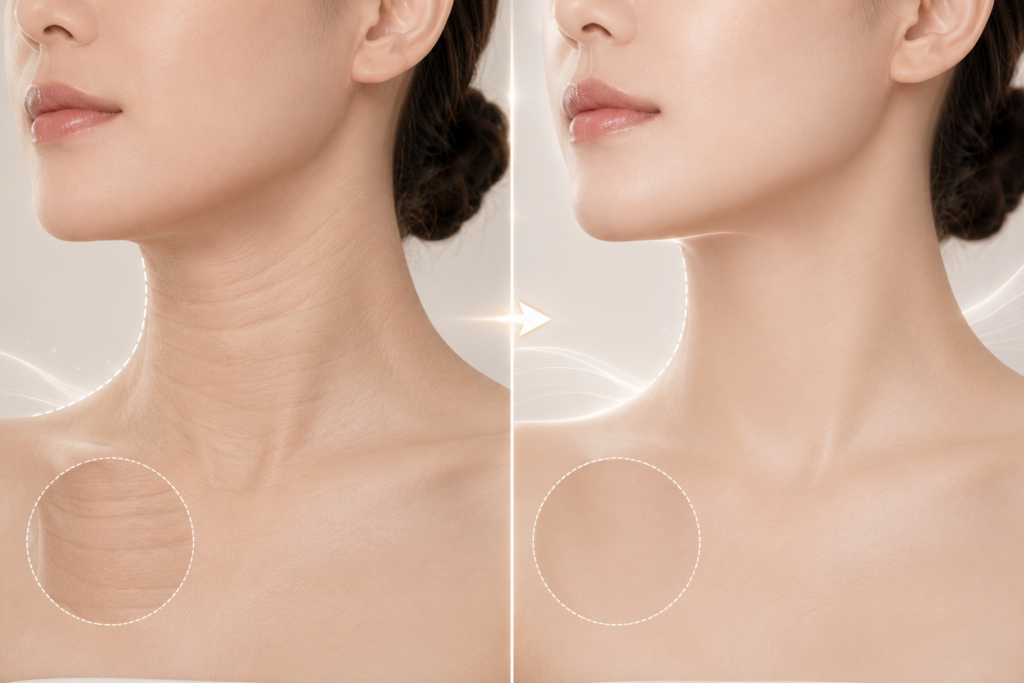
▲ (AI illustration) Through a bio-stimulation mechanism, this treatment promotes the gradual regeneration of collagen and elastin in the dermis, improving neck wrinkles and enhancing the skin’s overall elasticity and suppleness.
Before making a decision, there are a few things you should know first
If the lines on your neck are primarily caused by muscle tension, resulting in prominent vertical bands (commonly known as “turkey neck”), elastomeric needles may not be the most effective solution. In such cases, Botox is typically needed to relax muscle tension; if there is a single, particularly deep crease, local filler injections may also be required. This is why treatment planning requires a physician to personally assess the pattern of your lines and the condition of your skin, rather than simply copying what others have had done and applying it to yourself.
In addition, this treatment is not recommended for pregnant or breastfeeding women, individuals who are allergic to hyaluronic acid, or those with inflammation or open wounds at the treatment site. Please also inform your doctor in advance if you are taking anticoagulant medications or dietary supplements such as fish oil.
ARISIN CLINIC
Neck wrinkles aren’t caused by a lack of skincare—they require the right approach.
The doctors at Arixin Clinic will conduct a hands-on assessment of the appearance of your neck wrinkles and the condition of your skin,
We’ll design a treatment plan that’s truly tailored to you, rather than applying a one-size-fits-all approach.
The content of this article is for reference only. Actual treatment results may vary depending on individual skin conditions. Treatments carry risks and side effects; please consult a professional physician during your clinic visit for a detailed evaluation.