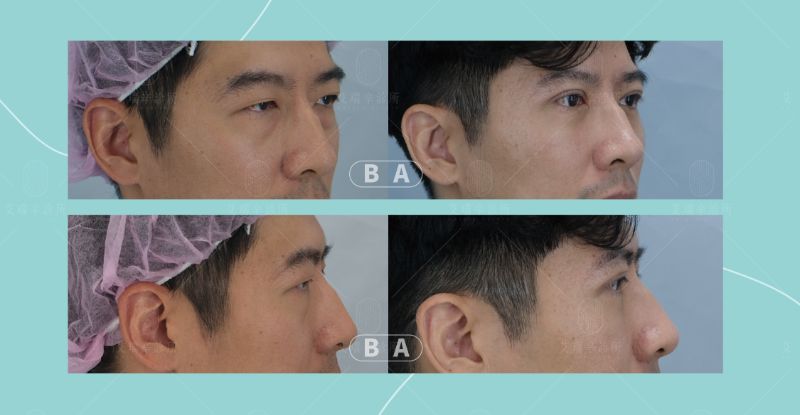




Eye Bag Surgery|Customized Evaluation of Internal/External Opening・Break the tear troughs and lighten the eye area.

Eye bags are formed when the fat in the eye socket protrudes outward due to the relaxation of the eye diaphragm. With ageing or hereditary factors, these bags make people look tired, haggard and old. Eye bag surgery is the most fundamental and long-lasting medical treatment to improve the problem of under-eye bags. There are two types of surgeries: "internal" and "external" according to the individual's condition around the eyes, and "fat transposition" can be performed at the same time to fill in the tear trough depending on the demand, solving multiple aging problems around the eyes such as under-eye bags, tear trough, and under-eye laxity at one time, and the effect is natural and long-lasting, and the traces of the knife are almost invisible after the surgery.
Service Description
There are three main causes of bags under the eyes that are oriented:

natural agingAs we age, the orbicularis oculi muscle declines, the ocular diaphragm (retaining wall) loosens, and the fat that was originally encased in the eye socket loses its support and begins to protrude outward to form bags under the eyes. At the same time, the skin under the eyes loses its elasticity, resulting in fine lines and laxity.
Genetic factorsSome people are born with shallow orbital bone structure or more fat in the orbital area, resulting in visible eye bags at a young age, which is not related to lifestyle but is a genetically determined structural problem around the eyes.
bad habit: Chronic sleep deprivation, high salt diet, excessive eye use, alcoholism, smoking, etc. may accelerate the formation of eye bags or worsen the puffiness.
Under-eye bag surgery addresses the root cause of under-eye bags by precisely removing or redistributing excess fat and repairing sagging skin. The results are long-lasting, usually lasting 5-10 years or more, and are truly radical in ways that cannot be achieved with topical moisturizers or non-invasive treatments.
Detailed explanation of the two major techniques
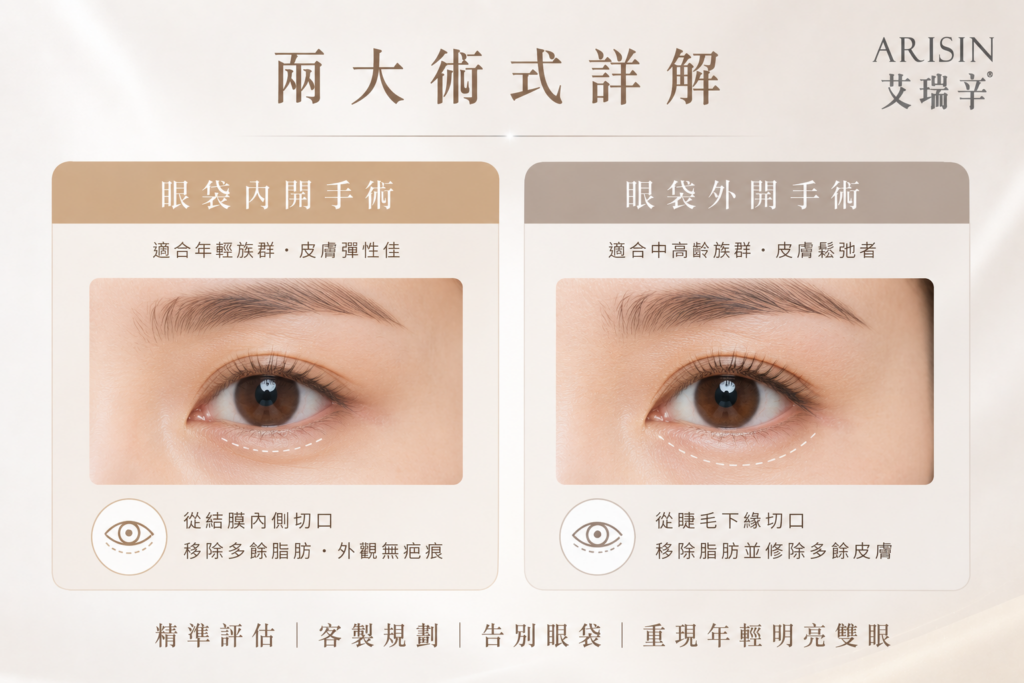
Transconjunctival Lower Blepharoplasty (Blepharoplasty)
Incision LocationThe incision is made in the conjunctiva of the medial lower eyelid, a small incision of about 5mm, completely inside the eye, with no visible scar.
Principle of Surgery: The surgeon enters through an incision on the inner side of the conjunctiva and accurately removes or relocates the protruding excess fat under the eyes without leaving any external incision on the skin of the face, making the surgical marks almost undetectable after the operation.
Advantages
- No external scars, completely natural looking
- No wire removal (or removal of fat transposition fixation wires only)
- Shorter recovery period (about 7-10 days)
- Less intraoperative bleeding and swelling, relatively easy post-operative care
- Simultaneous fat transfer to fill the tear troughs, treating both bags and tear troughs in one go.
Disadvantages
- Unable to synchronize the treatment of skin laxity and fine lines around the eyes.
- Limited to those with good skin elasticity.
Suitable Groups: 20-45 years old, with firm skin under the eyes, fat protruding from the eyes (fat type eye bags), and tear trough depression.
Transcutaneous Lower Blepharoplasty (Lower Blepharoplasty)
Incision LocationThe scar is hidden in the natural crease under the eyelashes and fades to almost invisible in about 3-6 months.
Principle of Surgery: The surgeon sequentially separates the skin from the orbicularis oculi muscle, treats the protruding fat (removes or translocates it), and simultaneously lifts the loose fascial layer and precisely trims the excess loose skin before suturing it back together to comprehensively improve the problem of aging under the eyes. For severe under-eye bags combined with sagging of the mid-face, a simultaneous mid-face lift can be performed.
Advantages
- Simultaneously treats fat bags, sagging skin, fine lines under the eyes, tear troughs and other problems
- Suitable for all ages and severity of eye bag correction
- Improves the overall effect of medium to severe eye bags and aging around the eyes.
- Can be combined with a center face lift to lighten a larger area of the eye area at once.
Disadvantages
- Post-operative visit for suture removal (about 5-7 days)
- Longer recovery period (about 7-14 days)
- Initially, there is a fine linear scar underneath the eyelashes, which fades in about 3-6 months.
- Higher level of surgical skill and more stringent requirements on the surgeon's experience
Suitable Groups: 35 years of age or older, with noticeably loose skin under the eyes, fine lines, moderate to severe bags under the eyes, structural dark circles, and sagging apple muscles.
Orbital Fat Repositioning
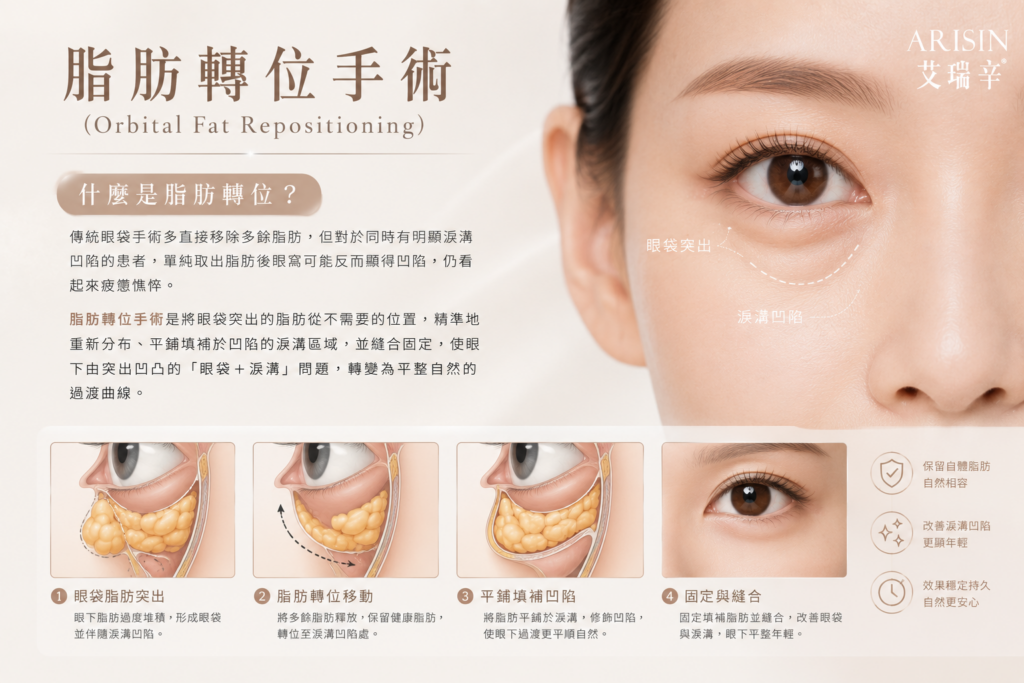
Advantages of Fat Transposition
- Retaining the original vascular supply of the fat, the survival rate is higher than that of autologous fat grafting.
- No need to remove fat from the body, one operation to solve the eye bags and tear troughs at the same time.
- Effective in preventing the common post-surgical orbital pitting syndrome
- Can be performed with either internal or external openings
Points of AttentionLipotransfer is a difficult procedure and requires an experienced surgeon to accurately assess the amount and location of the fat transfer in order to avoid the problem of unevenness after surgery. If the tear trough is deep and the amount of fat under the eyes is small, the effect of fat transfer alone may be limited, and can be combined with hyaluronic acid injection or autologous fat backfill, depending on the situation.
Inside vs. Outside vs. Fat Transposition Comparison Table
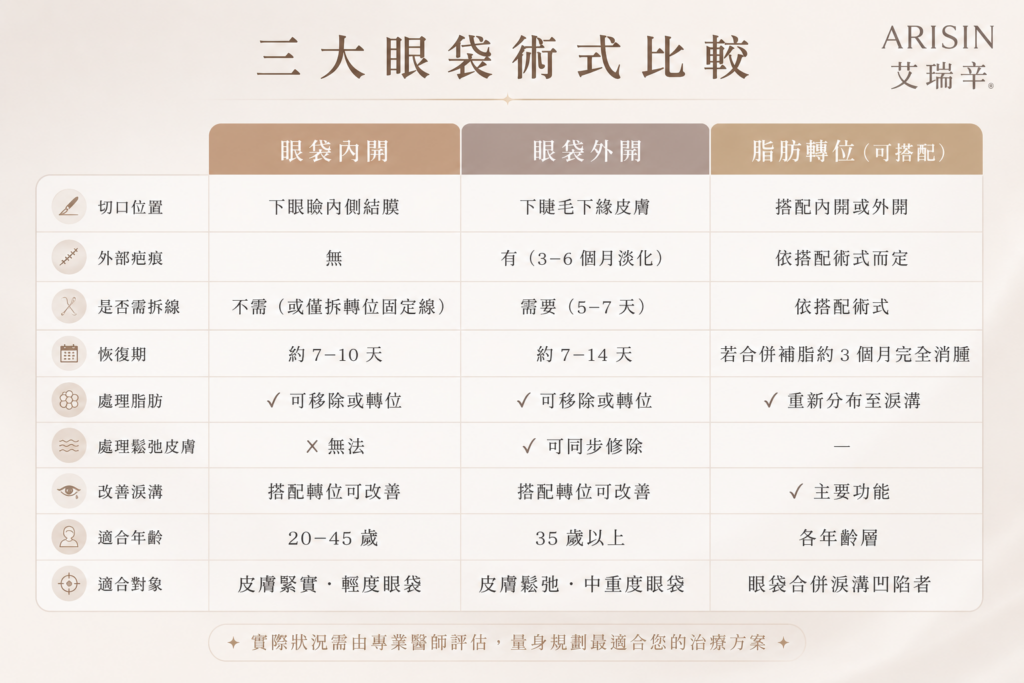
Description of the recovery period
Surgery for bags under the eyes
- 1-3 days after surgery: swelling and bruising are most obvious, ice packs and adequate rest are recommended.
- 5-7 days after surgery: substantial improvement in swelling, if there is any fat transposition fixation line need to return to the clinic for removal.
- 7-10 days after surgery: most patients can resume normal social life
- 2-4 weeks after surgery: more than 70% of the swelling has subsided, and the appearance is more natural
- If combined with autologous liposupplementation: the swelling of the liposupplemented area should be completely reduced in about 3 months.
Surgery for Eye Bags
- 1-3 days after surgery: swelling and bruising are most obvious, ice packs and rest are recommended.
- From 3-4 days after surgery: warm compresses can be used to promote blood circulation and accelerate swelling.
- Post-op 5-7 days: the sutures are removed at the follow-up visit and the swelling begins to improve significantly.
- 7-14 days after surgery: most patients resume normal socialization
- 1-3 months after surgery: Scars gradually fade to a natural appearance.
- Complete resolution: Some patients may take 1-3 months.
Pre-operative Note
- Stop using aspirin, anticoagulants, fish oil, ginkgo, ginseng, vitamin E, etc. 1 week before surgery to reduce the risk of intraoperative bleeding.
- Inform your doctor of your medical history, allergy history, and current medications (including Chinese medicines and health food) before surgery
- Please inform us if you have had myopic laser surgery (LASIK, etc.) beforehand.
- Please inform your doctor in advance if you have crabs' feet or hypertrophic scars.
- Patients with chronic diseases such as cardiovascular disease, diabetes, thyroid disease, etc. should be informed in advance.
- No food or water for 8 hours prior to surgery (hypnotic anesthesia).
- Keep clean the night before surgery, no nail polish, no makeup, no valuables
- You must be accompanied by a family member or friend on the day of surgery, and cannot drive on your own.
Post-Operative Attention
3 days before surgery
- Apply ice packs for 15-20 minutes each time, 4-6 times a day to help reduce swelling and relieve pain.
- Properly elevate the head during sleep to minimize the accumulation of blood around the eyes.
From the 4th day after surgery
- Change to warm compress to promote blood circulation and accelerate swelling and bruise metabolism.
Daily Care
- Keep the wound dry and clean. Avoid raw water and foam in the eyes when washing face and hair.
- Gently wipe the wound with a sterile cotton swab moistened with saline and apply ointment as directed by the doctor.
- Take eye drops on time
- Get enough rest after surgery, avoid staying up late and over-exerting your eyes, and reduce the use of 3C products.
- Avoid bending down and lifting heavy objects to prevent increased intraocular pressure and risk of bleeding.
Food & Living
- Avoid excessively hot and spicy food to avoid redness and congestion of the face.
- 1 week rest after aerobic surgery, 2 weeks rest after retraining
- Avoid hot springs, triple warming, and strenuous exercise for 1 month.
- Enhance sun protection and avoid direct sunlight on the surgical area.
Abnormal Condition
- If there is obvious inflammation (redness, swelling, heat, increased pain) or unusual discharge, please return to the clinic immediately.
Contraindications (prior notification or evaluation by a physician is required for the following)
- People with thyroid disease (thyroid problems may affect the tissues around the eyes)
- People with bulging eyes
- Coagulation abnormalities
- Severe Scarring (Crab Foot Swelling)
- People with major cardiovascular diseases
- Pregnant or breastfeeding women
The contents of this page are for reference only. The actual surgical methods, results and risks may vary depending on the individual's condition, and should be decided by a plastic surgeon after an in-person evaluation. Surgery involves medical risks, so please be sure to choose a legitimate medical institution and a qualified plastic surgeon for consultation and surgery.