



The silicone gel implants (cohesive silicone gel implants) used in modern breast augmentation surgery consist of three to four layers of outer shells with different functions. They contain highly cohesive silicone gel and have received triple certification from the U.S. FDA, the European CE Mark, and Taiwan’s Ministry of Health and Welfare, ensuring their safety and stability.
The primary goal of the surgery is to achieve natural, long-lasting, and proportionate breast augmentation results by selecting the most appropriate implant material, size, and placement based on the individual’s chest width, skin thickness, muscle condition, and desired outcome, all while minimizing side effects.
A Detailed Guide to the Three Main Types of Breast Implants
I. Queen Wave (Mentor Xtra) | Smooth Surface, High Fill

What is the "Queen Wave"?
Queen Wave (Mentor Xtra), developed by Mentor in the United States, is one of the most talked-about new-generation smooth-surface breast implants currently available on the Taiwanese market. Its most notable feature is the use of99% Ultra-High Filling RatioPairingShaping Energy Gel Technology...allowing the breast implants to combine the shape retention of teardrop-shaped implants with the soft, natural feel of round implants, presenting different natural contours when standing and lying down—a feature many patients describe as “teardrop-shaped when standing, round when lying down.”
The Five Key Features of Queen Wave
- 99%: Ultra-High Filling Rate · Reduced Water Ripples The fill rate for standard smooth-surface breast implants is typically around 85–95%, while the fill rate for Queen Wave implants reaches as high as 99%, significantly reducing the “rippling” caused by underfilling and resulting in a fuller, more natural contour.
- Shaping Energy Gel—Combines Support and Softness Featuring Manto Grade 1 memory gel and a contouring energy design, the Queen Wave implant achieves a teardrop-shaped contour while maintaining softness. It resists soft tissue encapsulation, preserving the implant’s shape retention and elasticity.
- Three-layer silicone outer shell · Pressure-resistant and shatterproof The outer membrane structure features a three-layer silicone design with an elongation capacity of up to 7 times its original length and can withstand a pressure of 225 kilograms, significantly reducing the risk of rupture.
- Capsule contraction rate less than 1% Clinical data show that the capsular contracture rate for the Queen implant is lower than that of the 1% implant; it offers excellent resistance to contracture and can maintain stable breast shape over the long term.
- Designed for Asian Women's Chests The bra's design is optimized for Asian women, who tend to have a narrower underbust measurement, allowing even those with a slimmer build and a narrower bust to achieve a fuller-looking bust.
Who Should Try the "Queen Wave"?
- For those seeking a balance between shape retention and a soft feel
- Asian women who are slimmer and have narrower chests
- Those who wish to reduce the risk of water ripples
- For those who don’t want frequent massages and prefer simpler post-treatment care (compared to traditional smooth surfaces)
II. Mentor Smooth | Classic Soft Feel
What is a Mandala-smooth surface?
Manto Smooth is the most traditional and longest-established material for breast implants. With a smooth surface and a disc-shaped design, it is one of the softest options available on the market. Because of its smooth surface, the implant has a certain degree of mobility within the pocket, allowing the breast to exhibit a natural, realistic sway—closest to that of a real breast—during movement (such as walking, swaying, or lying flat).
Features of the Manto Smooth Surface
- Excellent flexibility: The surface is smooth and frictionless, allowing the breast implant to move freely within the chest cavity; it feels exceptionally soft and offers a texture and elasticity similar to that of a natural breast.
- Natural swaying sensation: Due to the high glide rate, there is a realistic sensation of breast movement when walking or moving, and the appearance is extremely natural.
- Full upper chest: The disc-shaped design enhances the upper bust, creating a visually round and full silhouette.
- Relatively good value for the price: Compared to newer breast implants, the Mandu smooth-surface implants are more affordable and are suitable for those on a budget.
Precautions for Mandala Smooth Surfaces
- Regular massage is required after surgery.: Because the surface is smooth and the implants tend to shift frequently, you must follow your doctor’s instructions and massage them regularly after surgery to reduce the risk of capsular contracture.
- The risk of capsular contracture is relatively high: Frequent tissue friction accelerates capsule formation; if massage is not performed properly, the likelihood of capsule contracture is higher than on the villous surface.
- May cause ripples in the water: If the fill rate is less than 99%, ripples may appear on the side when lying on your side.
- A post-surgery lifestyle that requires a high degree of self-discipline: Those with a regular schedule who can commit to regular massages are the best candidates.
Who Should Use Mandala Smooth Surface?
- For those seeking the softest feel and the most realistic wobble
- Those with a regular daily routine who are able to comply with postoperative massage
- For those who want a full, rounded upper chest
- Target Audience Based on Budget
III. Mentor Siltex Velvety Surface
What is a velour fabric?
The Mandala textured surface (also known as a matte or micro-textured surface) is a new-generation breast implant surface technology that has rapidly gained popularity in recent years. The implant surface features an extremely fine nano-textured structure (virtually invisible to the naked eye), which allows the implant to adhere closely to the surrounding tissue, significantly reducing the frequency of implant slippage within the pocket and, consequently, markedly lowering the incidence of capsular contracture. Common examples of Mandu textured breast implants in the Taiwanese market include Motiva, Pearl Wave, Soft Drop, and Goddess Wave.
Five Key Features of Manta Fleece
- The incidence of capsular contracture is extremely low The nano-fibrous structure allows the breast implant to conform closely to the surrounding tissue, effectively reducing excessive capsular hyperplasia. It is currently the breast implant material with the lowest risk of capsular contracture on the market and is particularly suitable for busy individuals who are unable to perform regular massages.
- No massage required after surgery Because textured implants fit snugly against the tissue, they do not require the daily, thorough massaging that smooth-surface implants do, making postoperative care relatively easier and allowing for greater freedom in daily life.
- Feels natural and close to a real breast The velvety surface of the implant enhances its fluidity and softness, providing a texture that closely resembles the supple, natural feel of a real breast. Compared to the rough, traditional velvety surface, it feels softer and more natural to the touch.
- Excellent biocompatibility The nano-fibrous structure allows the breast implant to integrate closely with human tissue, offering superior biocompatibility and ensuring long-term stability without displacement or rotation.
- Suitable for all lifestyles No need to stick to a regular massage routine—it’s perfect for modern women with busy work schedules, active lifestyles, or irregular daily routines.
Precautions for Manta Fleece
- Implants integrate well with the surrounding tissue, so removing them can be somewhat more challenging.
- For certain brands and models, there are a wide variety of options available; it is recommended that a physician assess the most suitable brand and specifications based on your individual breast shape.
Who Should Use the Manta Fleece Lining?
- Those who are unable or unwilling to get a massage every day
- People with busy lifestyles and irregular schedules
- Those who are particularly concerned about the risk of capsular contracture
- For those seeking low-maintenance, high-flexibility results after surgery
- People who are more physically active
Comparison Chart of Three Types of Breast Implant Materials
| Queen Wave (Smooth Surface, High Fill) | Manta Smooth Surface | Velvet-textured surface | |
|---|---|---|---|
| Surface Material | Smooth Surface (99% Filled) | Smooth Surface | Nano-fiber (matte finish) |
| Shape | Stand on a Water Drop · Lie on a Disk | Disc-shaped | By Brand (Disc or Teardrop) |
| Flexibility | High (Grade 1 Memory Gel) | Extremely high | High (close to a real breast) |
| Sense of swaying | Nature | Most Natural | Nature |
| Ripple Effect Risk | Very low (99% fill) | 中 | 低 |
| Risk of Capsular Contracture | Low (< 1%) | middle to high | Extremely low |
| Massage is required after surgery | Recommendation (easier than traditional smooth surfaces) | Massage regularly | unnecessary |
| Biocompatibility | Good | Good | Excellent (fits snugly against the tissue) |
| Suitable Groups | Striving for a Balance Between Shape and Softness: The Asian Thoracic Cage | For those seeking ultimate softness and a rhythmic massage | Busy people, those who don’t want a massage, and those with low-risk needs |
Selection of Surgical Incision Site
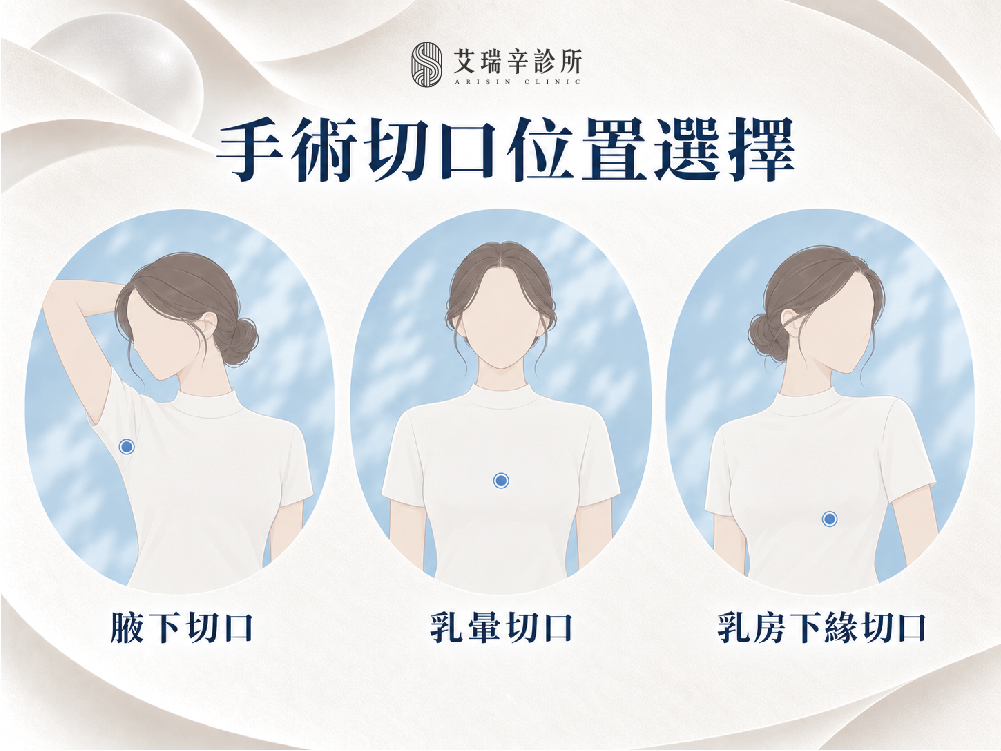
Breast augmentation surgery is classified into three types based on the incision site, each with its own advantages and disadvantages. The surgeon will evaluate the best option based on the individual’s specific circumstances:
Axillary incision (most common) The scar is hidden within the natural creases of the armpit, making it virtually invisible when wearing a bikini, low-cut clothing, or raising your arms; it is the most popular incision option in Taiwan.
Areolar incision The scar is hidden at the junction between the areola and the skin; its color is similar to that of the areola, making it difficult to notice once healed. This method is suitable for individuals with larger areolas.
Inferior mammary incision The scar is located in the inframammary fold, where the surgical incision is shortest and the field of view is clearest; this approach is more common in Europe and the United States. Since Asian individuals are more prone to keloid scarring, a careful evaluation by a physician is required.
Breast Implant Placement
Submuscular (Full Submuscular / Dual-Plane) Implants placed beneath the pectoralis major muscle provide excellent natural coverage, feel more natural, and have a lower risk of capsular contracture; they are suitable for individuals with thinner subcutaneous tissue in the breast area.
On the muscle (subfascial) Implants are placed above the pectoralis major muscle, resulting in less surgical trauma and a shorter recovery period, and providing a fuller appearance in the upper chest; this approach is suitable for individuals with ample natural breast tissue.
